Toyota’s Monza warning starts with qualifying
Toyota heads into Sunday’s WEC finale at Monza facing a pace deficit it describes as a “big gap” to its rivals. The warning follows the team’s worst qualifying result of the 2026 season, raising the prospect of its toughest race of the year.
That’s more than a poor grid position: qualifying has exposed a gap Toyota now expects to carry into the final round. The opening information offers no lap times or explanation for the shortfall, so it’s too early to tell whether the team can close it over race distance. For now, Toyota’s own expectation sets a stark tone for Sunday.
Toyota’s title hopes meet a pace problem
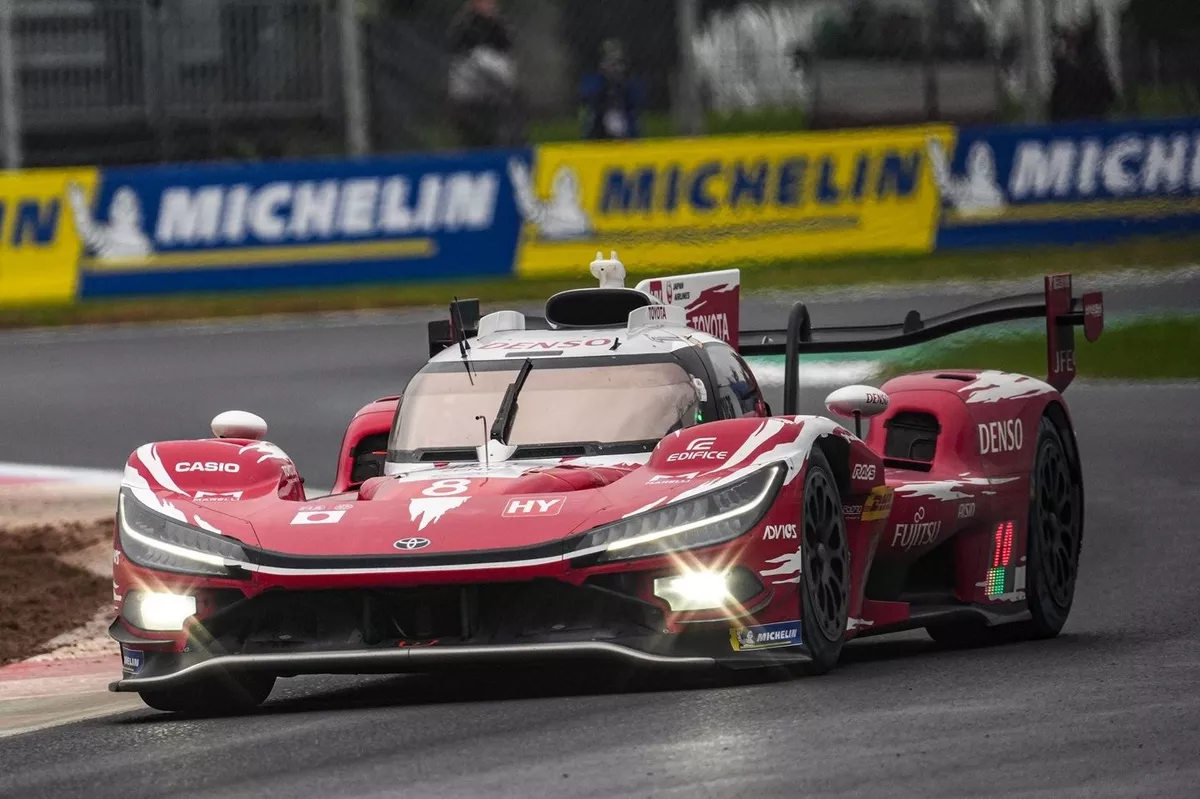
Sebastien Buemi, Brendon Hartley and Ryo Hirakawa, #8 Toyota TR010 Hybrid
Photo by: Alessio Morgese / NurPhoto via Getty Images
Toyota’s strategic reputation may help it in a six-hour race, but Ryo Hirakawa’s blunt assessment after qualifying was that the car first needs to find speed. The two TR010 Hybrids will start 15th and 16th at Monza, ahead of only Dries Vanthoor’s #15 BMW M Hybrid V8. Hirakawa called Toyota “too slow” and questioned whether clever calls could make up the difference.
The disrupted preparation offers some context. Persistent rain on Friday and Saturday morning left teams with little representative slick-tyre running in the three practice sessions. Toyota had no dry running before qualifying, while some rivals had tested at Monza. The circuit was also a difficult return: the WEC had not raced there since the #7 Toyota won in 2023.
“It was the same for everyone, no dry running until qualifying, so it was really tricky,” Hirakawa said. Toyota had to make set-up choices largely by guesswork, he added, and “even in the wet, we didn’t have a really strong pace.” He said the car was losing time across the circuit, including on the straights.

#8 Toyota Gazoo Racing Toyota TR010: Ryo Hirakawa
Photo by: FIA WEC / DPPI
That is a notable weakness for a team whose operational decisions have helped deliver results this season. Hirakawa, Sebastien Buemi and Brendon Hartley won September’s Fuji 6 Hours after a well-timed pitstop. At Monza, though, Hirakawa said strategy could only do so much: “In terms of pace, whatever strategy you do, our car is too slow.” He wants Toyota to improve the car before Sunday, while staying ready to seize an opportunity if one appears.
A title within reach, but not the way Hirakawa wants it
Hirakawa blamed the smooth surface for making it harder to bring the tyres up to temperature. Monza was resurfaced in 2024, and he said Toyota had struggled to switch the tyres on. He hoped hotter conditions on race day would bring better pace, though the available evidence doesn’t show whether temperature alone will be enough.
The #8 crew enters the final round with a 17-point championship lead. With 25 points available, the #7 Toyota trio of Mike Conway, Nyck de Vries and Kamui Kobayashi must finish in the top two to retain a chance of taking the title from their teammates.

#8 Toyota Gazoo Racing Toyota TR010: Sebastien Buemi, Brendon Hartley, Ryo Hirakawa
Photo by: FIA WEC / DPPI
A weak result from Toyota would hand the championship to the #8 crew automatically. Hirakawa made clear that an unearned-looking title would leave him dissatisfied: “I don’t want to finish last and then win the championship.” He said the team would treat the race as preparation for next year and do its best.
Toyota technical director David Floury described the qualifying result as a mix of car pace and execution. The team had little useful running in damp conditions either: the #7 car’s only prior outing came amid traffic, he said, and Toyota was below its best in both set-up and driving for qualifying. Floury expects a sizeable gap in the race, but believes a podium remains possible if the team is creative.
The manufacturers’ championship is already secured for Toyota, so Floury says the two cars can choose their own race strategies without team orders. Usually, he makes the calls; this time, he said, he doesn’t want to split the strategies or decide which car gets which approach.
Toyota’s drivers have room to race each other now that the manufacturers’ title is settled. That change could make the team’s strategy calls more interesting: Toyota will offer guidance, but leave the #7 and #8 crews freer to choose their own approach.

The team says it usually splits strategy to serve its overall interests. With the manufacturers’ championship secured, it no longer needs to manage the two cars as closely. Toyota will tell each crew what it believes is the best option, while allowing them more latitude than usual.
There’s a practical limit to how separate those choices may be. Toyota expects one car to watch what the other does: if #7 tries a different move, #8 could follow on the next lap. That’s only the team’s prediction, though. The final calls belong to the drivers and crews.
How much freedom they use remains uncertain. Still, the shift matters: with the team title settled, Toyota can let the race unfold with more tactical flexibility—and see whether either car can gain an edge through a choice the other hasn’t yet made.